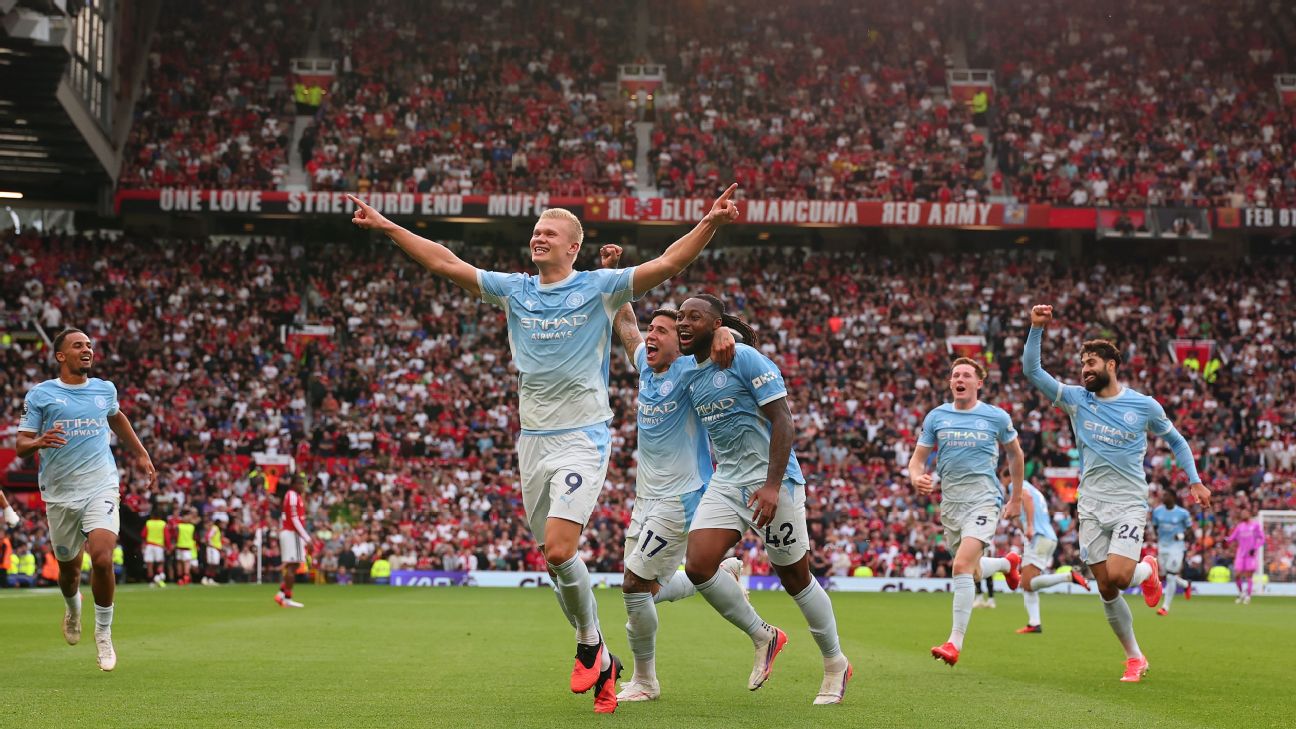
Football rarely respects logic, and Old Trafford witnessed the proof. Manchester City, a man light for more than an hour, walked out of the theatre of their oldest rivals with a 1-0 win that felt equal parts smash-and-grab and statement of will. It was Erling Haaland, of course, who applied the finish, and it was Manchester United who were left staring at the wreckage of an afternoon that promised so much and delivered nothing.
The numbers alone told a story of what should have happened. Phil Foden was dismissed on twenty-three minutes, City forced to spend the remainder of the contest riding a numerical disadvantage in front of a raucous home crowd. And yet the visitors held their nerve, kept their shape, and found the single moment of quality the game required. For United, the disappointment cuts deeper for the opportunity squandered.
This was a derby that will linger for the wrong reasons in the red half of the city. A chance to bloody the nose of a title contender, to haul themselves up a table that already reads uncomfortably, went begging. Instead they slipped further into the murk, while City marched on with the swagger of a side that believes it simply does not lose.
Foden's flashpoint
The afternoon pivoted on a single act of madness. On twenty-three minutes Phil Foden was shown a straight red card for violent conduct, an offence that left City to reorganise and United to sense their moment. Old Trafford roared, scenting blood, expecting the tide to turn decisively in their favour.
It was the sort of setback that has broken lesser teams. A man down in the cauldron of a derby, against opponents desperate for a result to rescue a stuttering start, City might have been forgiven for retreating into damage limitation. The dismissal reshaped the entire complexion of the contest and handed United the initiative on a plate.
But the numerical advantage, so often decisive, became a burden United could not turn to their favour. The extra man demanded patience and precision, and as the minutes ticked by without reward, frustration began to gnaw. City, meanwhile, dug in, and the longer the game stayed level the more the visitors grew into it.
Haaland strikes
The blow, when it came, carried an air of inevitability. On the hour Erling Haaland found himself in the one place a defence never wants him, on the right side of the six-yard box, and stabbed a left-footed finish high into the centre of the goal. There was a pause, a VAR review, and then the confirmation that turned City's bench into a scene of delirium.
For a striker of Haaland's ruthlessness, a chance from that range is as good as a certainty. Ten men or eleven, City had constructed the moment their whole afternoon depended on, and the Norwegian did what he has always done. The goal stood, the scoreboard read 0-1, and the mathematics of the afternoon suddenly looked very different.
United needed thirty minutes to find a response and never came close to conjuring one. The extra man counted for nothing against a City rearguard that refused to buckle. The final whistle, when it sounded, confirmed a result that defied the run of the cards but honoured the run of the play.
Table takes shape
The consequences are stark. Manchester City sit second on twelve points, a perfect four wins from four, eight goals scored and only two conceded. This was a fourth straight victory, and one earned the hard way, the kind of afternoon that separates genuine contenders from pretenders. To win a derby with ten men for an hour is the mark of a side utterly certain of itself.
For Manchester United the picture is grim reading. Thirteenth on four points, a record of one win, one draw and two defeats, seven goals for and seven against, they are becalmed near the foot of the table when they should be surging. A single win from four is not the return of a club with their ambitions, and the malaise now carries the sting of a derby defeat.
The gap between these neighbours, eight points after only four rounds, feels larger than any table can convey. One side plays with conviction and cutting edge; the other searches for both. That City could stretch that gap while down to ten men only deepens the sense of a chasm opening between them.
What comes next
For City, the road ahead looks broad and inviting. Unbeaten, ruthless, and now proven under the most testing conditions, they travel on with momentum that will alarm the rest of the division. Winning ugly, winning short-handed, winning in enemy territory, these are the traits of a team that intends to be there at the death of the season.
United, by contrast, face a reckoning. Four points from four fixtures leaves little margin, and a squad this early into a campaign cannot afford to let doubt take root. The performance offered flickers of promise, particularly with the extra man, but promise without points is a currency that buys nothing in the Premier League.
The derby always carries weight beyond the standings, and this one will sting for months. City banked the bragging rights and the three points; United banked only the frustration of a chance that will not come around again soon. The recovery must begin at once, before thirteenth becomes a habit rather than a warning.